Showing posts with label trade surplus. Show all posts

Sunday, 4 March 2018

On trade, Trump and the Brexiteers are not as far apart as you might expect

When it comes to trade, liberal Brexiteers are cut from a very different cloth from Donald Trump. Or so we're led to believe.
Trump wants protection. But Brexiteers want more trade, even unilateral tariff cancellations on imports to the UK.
Trump has a pinched and paranoid vision of "America First". Yet Brexiteers nourish an expansive and open-minded dream of "Global Britain" signing major new deals with emerging market superpowers.
Trump is in the mould of his late 19th century predecessor, William McKinley, who proclaimed: "Protection is but the law of nature, the law of self-preservation, of self-development." Brexiteers such as Liam Fox, Boris Johnson and Michael Gove, by contrast, walk in the enlightened footsteps of John Bright, Richard Cobden and the Anti-Corn Law League.
But are Trump and the liberal Brexiteers as different as that rhetorical divergence suggest? As he unveiled his new tariffs on steel and aluminium last week, Trump articulated his philosophy on trade to Twitter.
"When a country is losing many billions of dollars on trade with virtually every country it does business with trade wars are good, and easy to win," he explained. "Example, when we are down $100bn with a certain country and they get cute, don't trade anymore - we win big. It's easy."
One can hear an echo of that "we can't possibly lose" perspective in the Brexiteers' misplaced confidence that, because the European Union has a trade in goods surplus with the UK, the Europeans will ultimately be desperate to sign a post-Brexit free trade deal.
"Within minutes of a vote for Brexit the CEOs of Mercedes, BMW, VW and Audi will be knocking down Chancellor Merkel's door demanding that there be no barriers to German access to the British market," the now Brexit Secretary, David Davis, famously predicted before the referendum.
What both the Brexiteers and Trump fail to understand is the nature of trade deficits. Trump is deluded to believe, as he clearly does, that a bilateral trade deficit is evidence of a country "losing" in trade and a surplus, correspondingly, evidence of "winning".
And the Brexiteers are deluded, albeit in a slightly different way, to believe we are, like a customer in a charity shop, somehow doing EU companies a favour in buying their exports - and that we could simply stop doing so without inflicting any harm on ourselves.
But, even accepting all that, Brexiteers would never advocate crude Trump-like tariffs, would they? Perhaps not. Yet leaving the EU single market and customs union are, nevertheless, inherently trade destroying policies for Britain; perhaps the most destructive since the Second World War.
No credible study has found any grounds for believing that hypothetical future trade deals between the UK and the likes of China and Australia could, arithmetically, compensate for leaving the EU's free trade institutions (which, let us remember, the Thatcher government helped to shape).
It's also worth delving a little more into the Trump position. On Twitter he embraces bellicose talk of a trade war. But speaking in Davos in January, the tone from Trump and his economic team was rather different. All they wanted, they said up in the Swiss Alps, was "fair trade", reform of a system "rigged" against America.
"The US is prepared to negotiate mutually beneficial bilateral trade agreements with all countries," Trump told delegates of the World Economic Forum.
This might get us closer to the underlying substance of the Trump position. What we have is a visceral rejection of multilateralism, or working in concert with other nations, as an equal, to achieve a mutually beneficial end. America will only negotiate with other countries one on one. For Trump, trade is really about power. It's an ideological view on the appropriate nature of international relations.
One of the most pointlessly destructive elements of Brexit when it comes to trade is that the UK will automatically fall out of the coverage of the 50 or so trade deals signed between the EU and a host of other countries, ranging from South Korea and Mexico to Chile and South Africa.
We will have to scramble to recreate those deals after 2019 merely to avoid damage to our own exporters who have come to rely on them. The net economic benefit of this upheaval is quite elusive.
Moreover, we might ask, what is the objection, if the Brexiteers feel the EU has not been proactive enough in seeking to strike new trade deals with emerging markets, to remaining in the bloc and pushing for change from within, working with similarly pro-free trade allies such as the Netherlands and Sweden?

The obvious answer is that liberal Brexiteers, like Trump, harbour a temperamental hostility to the very principle of multilateralism, even if it delivers the ends they purport to want. It's a hostility that overrides any rational cost-benefit judgement.
Working through the EU to enhance the export opportunities of our firms and reduce import costs for consumers would not enable these political narcissists to feel, on a personal level, that they had taken back control.
Despite their rhetoric, for liberal Brexiteers, leaving the EU is less about new trade opportunities, than power. And, as with Trump, the power in question is not really their country's but their own.

Sunday, 16 July 2017

There’s much to admire about the German economy. But its massive trade surplus is not one of them

Even stopped clocks are occasionally right, albeit by accident. Donald Trump has been complaining that Germany is “very bad on trade” and that the country’s whopping current account surplus (which hit $294bn last year, the biggest in the world) is a problem.

He’s right. Germany’s surplus really is economically harmful for the US. And, indeed, the surplus is a drag on the wider world too, not least the other members of the eurozone. But it’s not for the reasons Trump articulates.

For Trump and his advisers the surplus is evidence German politicians have been unfairly boosting the German export industry at the expense of US manufacturers. Yet that boost is really a by-product of large domestic imbalances in the Federal Republic, rather than the protectionist trick Team Trump imagines.

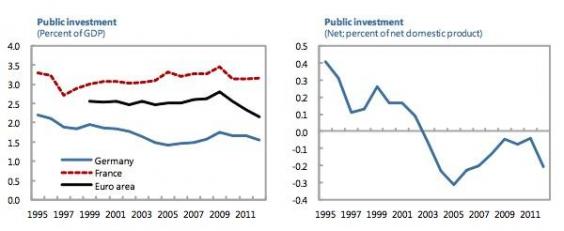
Here’s why. German households spend a relatively low proportion of their collective income. Private German businesses, in aggregate, invest considerably less than their collective profits. The German state’s infrastructure spending is also exceptionally weak as a share of GDP.

This economy-wide underspending means there is a chronic excess of national domestic saving over domestic investment in Germany. It follows as a simple accounting identity that this excess has to be exported abroad. There’s nowhere else for it to go. So Germany, through various means, acquires foreign currency assets on a massive scale every year.

For the likes of the US this pushes up the value of the dollar relative to the euro, imposing a headwind against growth in America. The same happens to the other countries whose currencies the Germans buy, including Britain. If the capital-absorbing countries want to offset that drag they have no choice but to borrow and spend more than their aggregate incomes, running current account deficits.

One of the consequences of those deficits and the undervalued euro is that demand for many German manufactured exports is artificially stimulated. Many German exports are, of course, famously high quality. But what matters is that the international demand for them is higher than it would be if Germans were not running such a large current account surplus.

The crucial point to recognise is that, as the economist Michael Pettis has long argued, outward capital flows predominantly drive the surplus nation’s net export performance. And it’s the domestic under-consumption that drives the capital flows. In the case of Germany this isn’t about rigged trade deals, as Trump seems to believe. It isn’t about crude protectionist currency manipulation either. It’s about too little spending within Germany.

Does it really matter though? Not in the near term. And it’s not plausible to blame economic weakness everywhere in the world on current account surpluses in Germany (and also China and Japan). There are plenty of other things going on too, not least excessively contractionary fiscal policies in many countries.

sectorallending.jpg
But those surpluses do encourage unbalanced growth, both in the deficit and surplus countries. In deficit countries sectors such as real estate are artificially boosted, while in Germany, China and Japan the manufacturers get a lift. The imbalances also lead to excess financial indebtedness in deficit countries, raising the risk of a messy unravelling down the line – if, say, foreigners suddenly attempt to deleverage all at once, or they lose the confidence of their overseas creditors.

Martin Sandbu, an economics writer at the Financial Times, has pushed back at multiplying complaints about Germany’s large surplus by pointing out that as long as the German current account surplus is stable, rather than growing, it is not subtracting from demand overseas. While narrowly true, this glides over the fact that Germany’s surplus has been rising steadily as a share of its GDP for almost two decades, shooting up from a deficit in 2001 to an 8.3 per cent surplus in 2016, and thus imposing a serious drag for much of the time.

And while it may not be subtracting from growth at this precise moment, the sheer size of Germany’s surplus represents the extent of economic benefit in terms of stronger demand and rebalancing that ought to flow to countries overseas. Some of the primary beneficiaries of healthier German domestic consumption would be its still-struggling eurozone neighbours such as Greece, Italy and Portugal. Every year the German current account surplus remains so high, means more debt has to be accumulated overseas.

publicsector.jpg
So why is Germany underconsuming and underinvesting? Part of the answer is that the admirable consensus approach between workers and employers in Germany that I mentioned last week has actually worked too well. Workers have accepted extreme pay restraint since the advent of the single currency in 2000 (often settling for awards below productivity growth) thus helping to squeeze down the share of wages in German GDP.

An outbreak of social anxiety about the ageing profile of Germany has also encouraged households to save well in excess of what is needed to meet the actual fiscal challenges of retirement. Weak household consumption has discouraged German firms from investing at home. And the German government has compounded this savings frenzy by taking fiscal prudence to a fault, running an absolute budget surplus, ignoring its responsibilities (and indeed long-term self-interest) to help keep demand strong and balanced in the eurozone overall.

German politicians often look on their large surplus with a sense of pride, seeing it as a symbol of national prudence and export success. Germany’s consensual post-war economic and political institutions do indeed deserve the world’s admiration. But its chronic underconsumption and large surpluses deserve to be buried, not praised.