Showing posts with label productivity. Show all posts

Monday, 26 November 2018

Interview: Adair Turner

Adair Turner is being provocative again.
Almost a decade ago now he scandalised bankers and traders (although not the general public) when he declared the work of financiers to be“socially useless”.
A few years ago he made himself almost equally unpopular in central banking circles by suggesting they should consider monetising debt to rebalance their economies.
And now Baron Turner of Ecchinswell’s latest thesis is that politicians, everyone from the Chancellor Philip Hammond down, are talking rubbish about productivity.
“Although what every politician always agrees is that the crucial thing we need to do is speed up the rate of productivity growth – every politician’s wrong!” the silver-haired 63-year old declaims in an interview with The Independent
Turner, whose technocratic career has taken him from the CBI, to the Climate Change Commission, to a major government review of pensions, to the chair of the Financial Services Authority, is now chair of George Soros’ Institute of New Economic Thinking. And the economic thinking he’s doing is certainly “new”. Downright heretical, many would say.
So what’s led him to this radical conclusion that we should stop obsessing about productivity growth? The answer is twofold.
First, he suspects automation is happening quicker than is being picked up by our official GDP statistics. Second, he thinks lots of the new service jobs being created as the mechanisable parts of the economy become more efficient are inherently “zero sum”, meaning they are competing for the distribution of wealth rather than its creation.
He gives an example of street sweepers and lawyers: “If we manage to create a totally effective automated street sweeping machine nobody would have a job as a street sweeper….But if we apply IT to the limit to law, there’ll still be lawyers. It’s just that each of these two highly paid lawyers will now have software that review not simply many cases, but every single case that there’s ever been”.
“What do lawyers do? They fight against each other. If you make lawyer A and lawyer B both much more skilled than they were before you can’t say there’ll be a better product, there’ll just be a more intense fight.”
He thinks that focusing on productivity growth in this context will not help to deliver a higher quality of living for most people. Indeed, he fears it could actually end up harming living standards, citing the example of those who provide social care for the frail elderly.
“What do we do with those jobs at the moment? We reduce their status and their cost. We put them up for competitive bidding. And we bid down the price. And then we do these gig economy games where people being paid to do social care of the elderly aren’t even employed for movement between client one and client two; we say you’re only working when you’re at the client. Then we tailorise their life. We say ‘you’ve got 14 minutes to clean someone’s bottom’…”
The solution, Turner says, banging the desk of his Mayfair office where we are meeting for emphasis, is simply to stop focusing on the bottom line.
“We’ve just got to pay more for social care – we’ve just got to make something which is valued. We’ve got to pay higher taxes to afford it. They’re never going to be high-paid jobs, but we should not be using the techniques of the market to skinny them down.”
He concedes the macroeconomics of his argument, laid out in an extensive lecture in the US earlier this year,is unproven. There are certainly many theoretical and empirical challenges that could be mounted. He also accepts that his thesis that we should focus more on distributing the GDP pie than growing the (measured size of it) will not be easily swallowed by the policymaking classes.
“Ten years ago I said precisely the opposite,” he smiles. “That’s undoubtedly [not] what I would have said when I was director of the CBI. I’m still cautious about leaping to that. But sometimes a useful role in public debate is to throw something deliberately provocative into the pond!”
Turner advises a start-up online bank – OakNorth – which he says has influenced his views on the rapid underlying speed of job-shedding automation.
As chair of a group called Energy Transitions Commission (ETC) group, made up of public and private sector experts and executives, he’s also advising governments in China and India on decarbonisation.
Despite Donald Trump’s withdrawal of the US from the Paris Accords, Turner insists he’s relatively hopefully about the prospects of cracking the problem of a rapidly overheating planet.
“We’re optimistic that there are bits of Indian policy that are heading in the right direction. I’m optimistic that China gets it, that they are determined eventually to bring down their emissions, that they’ll develop renewables on a massive scale, that they’ll electrify their bus fleets etc,” he says.
“The thing that frustrates me about climate change is that we could get to 2060 and we could have a pretty close to zero carbon economy. Run the numbers and it’s completely doable by technologies that we know how to do. It is soluble if we just get on with it.”
But what’s lacking from Turner’s employment portfolio is a major, high-profile, public sector job in the UK. Jeremy Corbyn’s Labour seems an obvious fit. They could use someone with Turner’s economic and establishment credentials.
And it turns out there has been some contact. On 19 May (the same day as the Harry and Meghan Markle’s wedding) Turner was to be found addressing Labour’s macroeconomic conference.
But could he work with a party who many in the business world regard as unreconstructed Marxists, a bigger threat to the economy even than Brexit?
“The answer is I’d have to spend a bit more time,” he says, judiciously. “There are some things about some of the people around them of which I am suspicious. There seem to be some people around then who genuinely do believe that Venezuela is a well-run country. You cannot believe that and be sensible. Venezuela is a disaster and it has been destroyed by a left-wing Marxist government that had oodles of oil revenues. You’ve got to say the way that the world is.”
But he’s certainly not shutting the door.
“There are things that make me wary of that tradition on the left which can see no problems with left-wing governments. On the other hand, there are other aspects of what they are saying that do not seem all that extreme or worrying.”
The supreme British establishment technocrat taking a job with a radical left Labour team? That could be a Turner provocation to put all his others in the shade.

Sunday, 24 June 2018

Serious questions are being asked about what we want from central banks – and not before time

What numbers should central bankers like Mark Carney, Mario Draghi and Jerome Powell go to bed thinking about? Inflation? The rate of unemployment? GDP growth? Productivity? In other words, what should the target of an independent central bank be? After several years of lying dormant, this old question has, if not quite exploded in a volcanic eruption of debate, at least begun to rumble again.
Labour broached the issue last week with its publication of a report for the party by GFC Economics which suggests the Bank of England's mandate ought to be modified to include a target of 3 per cent annual productivity growth. This follows a paper earlier this month from Lawrence Summers (the veteran US economist who came close to being appointed by Barack Obama as the chair of the US Federal Reserve a few years ago) suggesting the Fed ought to move to a "nominal GDP" target.
Although droves of politicians in the UK, the US and across the EU have moaned and even raged about the decisions of central banks in recent years - including Theresa May - virtually none have called for decisions on interest rates to be put back into the hands of politicians. Indeed, scarcely any have even called for the mandate of those banks to be changed. Like Stanley Baldwin's 1920s press barons, they seem to prefer the power of the bully pulpit without the tedious responsibility of actually having to do any thinking about the sensitive trade-offs inherent in their simplistic demands.
So, in this depressing context, this flicker of fresh thinking about central bank mandates is welcome.
Such a debate can help to clarify that central banks, despite the impression given by the populist agitators, are not a law unto themselves. Policymakers do not arbitrarily decide what is good for the public and what is to be avoided, who should be subsidised and who should be penalised, who should be made richer and who should be made poorer.
The banks are operationally independent only - they work to achieve broad goals set for them by elected governments. That's true of the Bank of England, the Federal Reserve, the European Central Bank and indeed all of the independent monetary authorities across the Western world, from Sweden, to Canada, to New Zealand.
But what should the democratically selected target of those institutions be? They have all traditionally been given (roughly) the same target of 2 per cent annual inflation, and told to aim to hit it over the medium term. However, there is no macroeconomic reason why 2 per cent inflation, as opposed to, say, 4 per cent, should be the magic number consistent with full employment, steady GDP growth and macroeconomic stability.
And indeed the Summers argument is that this old framework, which seemed to work reasonably well before the global financial crash, is now breaking down. In an era when both interest rates and inflation are apparently being chained down by powerful secular economic forces, monetary policy is left potentially impotent to restore growth in the event of a downturn. Summers wants a nominal GDP target (inflation and real growth added together) of 6 per cent.
For similar reasons, Simon Wren-Lewis of Oxford University prefers a primary target of maximising GDP growth, with an inflation target transformed into a backstop. Others have previously suggested simply raising the inflation target from 2 per cent to 4 per cent.
The objection of Bank of England policymakers and officials to GDP targets is that growth data from statistics agencies, unlike inflation data, is often revised over time, sometimes dramatically, and that setting this metric as the target could result in wild and damaging policy swings.
Advocates see this as an exaggerated technical quibble. It also fails to engage with the central objective of the reform, which is to shift the mindset of central banks so that policymakers and staff will no longer consider miserable productivity and weak GDP growth acceptable merely because inflation has been quiescent.
The usual response of institutional conservatives to the idea of raising the inflation target to 4 per cent is that it would shatter the central bank's credibility and befuddle the public although, in truth, there's not much real evidence to believe this. Reasonable people can differ about the relative strength of these mandate proposals and the various objections. Yet all sensible people should welcome the rumbling of a radical debate here.
It's true that it's unhealthy to expect central banks to solve all of a society's economic problems. These institutions cannot please all the people all the time. Yet it is healthy to talk seriously and constructively about what it is we want our central banks to do.

Sunday, 10 December 2017

The strange economic views of Conservatives on disability

Having spent eight months merely to get to the starting line for talks with the European Union on the vital issue of post-Brexit trade arrangements, British ministers are not, perhaps, in a good position to speculate on the lack of productivity of others.

But that didn’t prevent the Chancellor Philip Hammond suggesting before a parliamentary committee last week that one of the causes of our dismal national productivity performance in recent years has been the fact that there are more disabled people in the labour market than there used to be.

This is almost certainly wrong arithmetically, as the economist Chris Dillow pointed out in his reliably brilliant Stumbling and Mumbling blog. The numbers of classified disabled people in the jobs market has grown since 2013, from around 2.9 million to 3.5 million. 

But even if one makes the most extreme (and unrealistic) assumptions about the average lower productivity of these new entrants to the job market relative to the rest of the workforce, one cannot explain anything more than a minor slice of the UK’s yawning 20 per cent productivity shortfall relative to the pre-crisis trend.

Economists remain unsure of the reasons for our productivity disaster. But none of the multitudes of experts who have delved into the figures have come out arguing that increased employment of disabled people is worthy of even a passing mention.

Among the most frequently cited culprits are under-investment in new kit by companies, a lack of lending by weak banks, and “zombie” companies kept alive by low interest rates

Another plausible candidate, put forward by the Oxford University economist Simon Wren-Lewis, is that excessive spending cuts by the coalition and Conservative overnments have suppressed productivity-inducing demand – something that, of course, puts the blame at the door of Philip Hammond and his fellow ministers rather than disabled people.

Given the terrible stigma that already attaches to the disabled in the jobs market, a point made extremely powerfully here by my Independent colleague James Moore, why raise the issue at all in the context of a discussion of UK productivity?

There actually seems to be an unhealthy obsession in Conservative circles with the supposedly low productivity of the disabled. Back in 2011 the egregious backbench Tory MP Philip Davies suggested during a debate on the Employment Opportunities Bill that disabled people ought to be able to offer to work for less than the minimum wage in order to help them get onto the jobs ladder.

The former Conservative welfare minister Lord Freud was, similarly, caught claiming in 2014 that some disabled people are “not worth” the regulatory minimum hourly salary.

Rosa Monckton, writing in the bible of the Tory-supporting classes, The Spectator, earlier this year, argued that people like her disabled daughter, Domenica, should be allowed to work below the minimum wage.
Spot a pattern?
Some might have also spotted a conceptual problem with these various narratives. How can disabled people be simultaneously priced out of the labour market by the minimum wage and responsible for dragging down our national productivity at the same time?

Is it plausible to argue the minimum wage is serving to exclude disabled people from the jobs market when their participation rates have been rising? Yes, the increase could conceivably have been higher without the minimum wage. But very much higher?

And are disabled workers, on average, even less productive than the able-bodied? One empirical study of workers in an Australian call centre found that not only were disabled workers in the group just as productive as the rest of the workforce, but they tended to stay in the job for longer.

Other studies have found some evidence of lower productivity, but also unwarranted pay discrimination by employers. One significant theme that emerges from the literature is that the group of people classed as “disabled” is so heterogeneous, with such a broad range of capabilities, that it’s not a good idea to generalise.

A particularly important practical distinction is between those who were born disabled and those who became so later in life, because these groups tend to face pretty different sorts of challenges in the labour market.

But the way this issue is dealt with by some politicians suggests evidence and research are not really of much concern. Some elements within the Conservative Party appear to have a strange and unpleasant ideological conviction that the disabled, in general, ought to be paid less.

This article appeared in The Independent on 10/12/17

Thursday, 23 November 2017

Why the economic forecasts for Britain are so apocalyptic – and how much Brexit is to blame

The economic headlines of the past 48 hours have been thoroughly miserable, if not apocalyptic.
So what’s going on?
Has the UK’s economic outlook really suddenly become very much worse – or has this reckoning been coming for some time?
To what extent is Brexit to blame?
And is there any way out of this mess?
Below we explain what’s going on with the British economy behind the headlines.

The key is something called productivity….

The fundamental reason for those awful economic projections in the Budget is a severe downgrade in the Office for Budget Responsibility’s view of the UK’s potential productivity growth over the next five years.
Productivity is the amount of output the UK workforce as a whole can produce per hour of work. It’s essentially a measure of the efficiency with which the British people are working.
Productivity may sound like an abstract “economicky” concept, but it is fundamentally important for a host of more tangible economic data that households really do care about such as wages, interest rates and public spending.

productivity.jpg
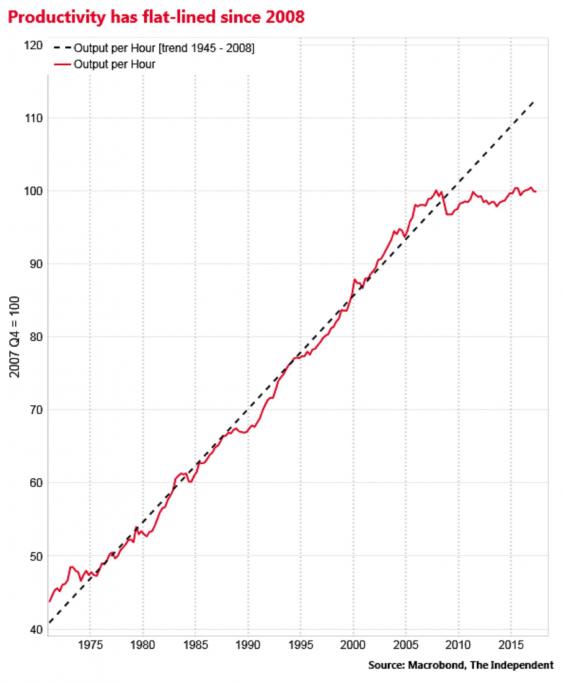
From the Second World War until the global financial crisis in 2008 the UK’s productivity reliably grew by around 2-2.5 per cent a year on average. There were recessions and crises over that time, but the overall economy always sooner or later got back to trend productivity growth, which means that wage and GDP growth etc, always eventually bounced back too.
But then the financial crisis hit and productivity has pretty much flatlined ever since. The Resolution Foundation has calculated that the past decade has actually been the worst for the UK’s productivity growth since 1812.

…and the Office for Budget Responsibility has become less optimistic about it…

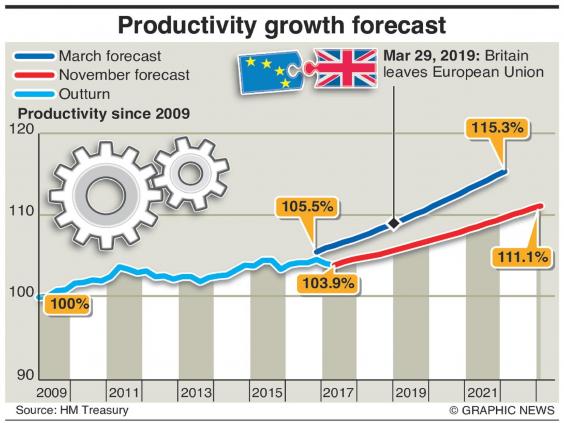
The independent OBR has been the Treasury’s official forecaster since 2010. And a key feature of all its forecasts since 2010 has been its assumption that the 2 per cent plus post-war trend rate of productivity growth would always return by the end of its five-year forecast period.

newchart1.jpg
But having seen all its previous forecasts prove woefully over-optimistic, it chose this week to break the habit. It now thinks UK productivity will only be growing an annual rate of just 1.3 per cent in 2022.

…so growth, wages and incomes are all expected to suffer…

Because the productivity outlook forms the basic building block of all GDP forecasts, the productivity downgrade is the reason why the OBR turned in the most miserable set of GDP growth forecasts for the UK since it was established seven years ago on Wednesday, with output growth never rising above 2 per cent over its five-year outlook.
Productivity is also the key determinant of wage growth. Many economists (although not all) take the view that if wages grow considerably faster than productivity the result is a surge of damaging inflation, which means that in inflation-adjusted terms, wages don’t actually grow at all.
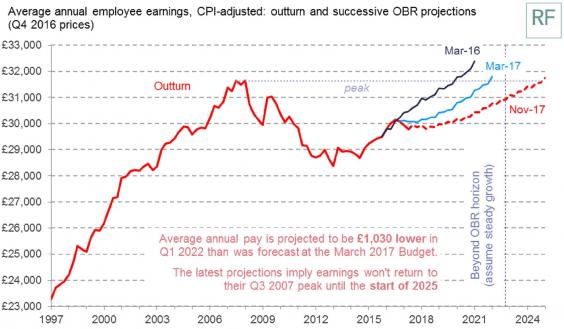
Average real wages in the UK are still around 6 per cent below where they were in 2008, with the blame being put on the fact that productivity has not grown over that time.
And because the OBR has severely downgraded its view of productivity growth over the next five years, that means it has also downgraded its forecast for UK wage growth.
Put the latest weak wage growth forecast from the OBR over the next five years together with the realised weak wage growth over the past decade and you have the shocking calculation from the Resolution Foundation: that wages are not projected to recover back to their 2008 level until 2025 – essentially 17 lost years for workers.

resolution.jpg

…and public services and welfare spending too…

The size of the economy has a profound influence on how much money the Government receives in taxes to spend on things like schools, hospitals, the police, the military and also cash transfers such as tax credits and other benefits etc.
Weak productivity growth leads to weak GDP growth which means pressure on public spending.
After the deficit shot up to 10 per cent of GDP in the 2008-09 recession the previous Chancellor, George Osborne, imposed severe austerity policies to curb state borrowing. He originally expected the job of reining in the Government’s deficit to be done by 2015.
But the economy has massively underperformed expectations, which means the deficit did not fall as planned and ministers have responded by prolonging the squeeze on public spending and benefits.
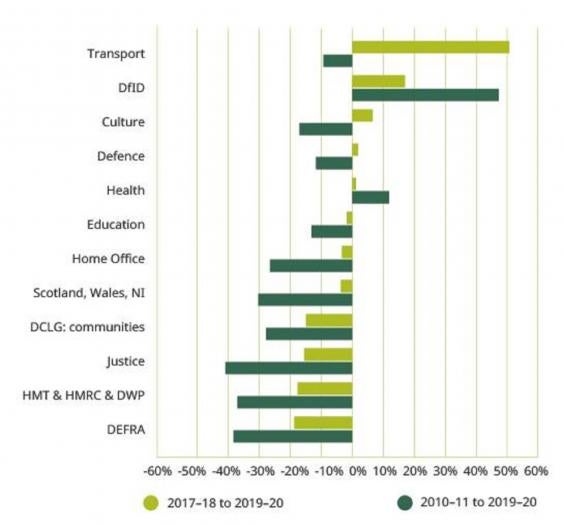
The budgets of some Whitehall departments are due to be cut by almost 50 per cent on 2010 levels by the end of the decade.

ifs.jpg
Real-terms UK departmental budget changes, 2010–11 to 2019–20, IFS
And though NHS spending has been growing in real terms since 2010, this has not been enough to met the demand generated by an increasingly elderly population, resulting in stretched waiting times for operations and over-crowded accident and emergency wards.

…Economists are baffled about productivity’s weakness…

Since productivity growth is the key piece in the economic jigsaw, economists have been keen to work out why it is so abnormally weak. If they can diagnose the illness they might be able to recommend a policy cure that will rectify it.
But, alas, in seven years of investigations they are still searching for a coherent and broadly accepted explanation for the productivity disaster.
Some explanations are UK-specific such as historic under-investment in workers’ skills here, an excessively flexible British labour market, an unusually sclerotic domestic banking sector, or even damagingly loose monetary policy from the Bank of England that has kept low-productivity “zombie” firms alive. Some blame the ready availability of low-skilled migrant labour from the EU.
And it is true that something is particularly awry here in Britain, where the level of productivity has long been worse than peer economies such as France, Germany and the US.
Yet productivity growth has also been weak by historic standards across the developed world since the global financial crisis and official forecasters have been reducing their projections for many countries, not just the UK.
One view advanced by the US economist Robert Gordon is that the advanced world in recent years has essentially come to the end of a long era of technologically-driven productivity growth that began in the industrial revolution and that the lower rates we are experiencing today are the new normal. Others, however, regard that as hyperbolically pessimistic and cite exciting recent advances in biotechnology, robotics, quantum computing and materials science, among other areas, as fundamental reasons to be optimistic about the future of global productivity growth.

…but economists generally agree that Brexit will make productivity worse…

One thing economists do generally agree on is that leaving the European Union and putting new trade barriers between Britain and our largest and closest trading partners is extremely unlikely to boost UK productivity growth – and is far more likely to retard it.
The OBR’s latest productivity downgrades are not, in fact, due to its view of the impact of Brexit but rather a capitulation to the view that it has been unduly optimistic about a natural bounce-back previously.
The productivity issue should be separated out from the short-term negative impact of the Brexit vote. The slump in sterling since the vote in June 2016 has pushed up domestic UK inflation, which has eaten into household incomes and curbed spending.
UK businesses are also investing less due to uncertainty over the outcome of government negotiations with Europe over future trade arrangements after March 2019. Both these factors have hit domestic demand and slowed the economy down this year, just as Europe and the wider global economy seem to be perking up.
A disastrous no-deal Brexit could well plunge Britain back into recession. But this should really all be thought of as distinct from the longer-running and underlying problem of UK productivity stagnation.

…and, actually, they do think there are things that can be done to improve UK productivity

Aside from not leaving the European Union’s single market and customs union, most economists believe that the best way of encouraging productivity growth, at least in the long-term, in the UK is more investment.
A big part of this is state investment in transport infrastructure, which helps make private-sector firms more productive. Another important form of state investment is in education and skills to make individuals more productive. There is also investment by firms into research and development in new technologies, which well-designed government tax and subsidy policies can encourage.
Corporate governance reforms might also help here, by removing the incentives on chief executives and boards to underinvest from their profits.
A specific area that economists, such as Andy Haldane of the Bank of England, are increasingly looking at is improving management systems at the UK’s less productive firms (of which there are many) in the hope of bringing them up to the levels of their higher-performing peers.
Another group of economists, including Simon Wren-Lewis of Oxford University, argue that the Government has actually been holding back domestic productivity-growth since 2010 through excessive fiscal austerity – and that budget cuts have thus been a false economy and a major policy mistake.
Their prescription is for the Government to stop obsessing about bringing down deficits and focus instead on keeping overall spending demand in the economy sufficiently high.

This article originally appeared in The Independent on 23 November 2017

Tuesday, 14 November 2017

Why we should worry less about inflation and pay more attention to wages

It takes two to tango. And it takes two economic statistics to create a squeeze on household living standards. The first is something we hear a great deal about: inflation. Most of us are well aware that inflation is up sharply since the June 2016 Brexit vote due to the slide in the pound, which has forced up import costs and made the goods and services we all buy more expensive.

The Bank of England hiked interest rates earlier this month, the first increase in the UK’s benchmark cost of borrowing in a decade, arguing that a monetary tightening is now necessary to bring inflation back down to its official 2 per cent target over the next few years.

But inflation above 2 per cent in itself is not an inherent problem. Eminent economists, including the former chief economist of the IMF, have suggested central banks should be mandated by governments to adopt a 4 per cent price target, double the current one. And though all the world’s independent central banks target it, there really is indeed nothing magic about a 2 per cent bull’s eye. So long as the rate of growth in a price index is stable it could be somewhat higher without the sky falling in.

Which brings us to the second crucial economic factor in determining the welfare of most households: wages. If UK wages were growing at their pre-financial crisis rates of 4 per cent plus, today’s inflation rate of 3 per cent would be perfectly bearable. In such circumstances real wages would be going up and most households would not be suffering from a cost of living squeeze.

But average wages are not growing at historic average rates. They are growing at only around 2 per cent. And this is not a recent deterioration. Average wages have been abysmally weak ever since Lehman Brothers went bust and we went into recession. On the current official forecasts we are set for the worst decade of pay growth since Nelson beat the French at Trafalgar.

Inflation, of course, matters. The Brexit vote undoubtedly delivered an unpleasant inflation shock to households via the record slump in the pound on the night of the referendum, when it became clear a majority of the British public had voted for an act of economic national self-harm.

But the Office for National Statistics reported that inflation remained at 3 per cent in October, despite expectations that it would go higher. This suggests that inflation might have peaked, that the one-off shock of the currency effect has worked its way through. There are strong reasons to believe that the Bank of England is wrong to believe that inflation would soon get out of hand without a rate hike.

The greater economic welfare challenge for the country as a whole is not inflation but wages. And here an emphasis on prices risks letting the Government off the hook. Ministers take the conservative economic view that wages are determined by productivity growth – the degree to which we are becoming more efficient in producing goods and services – and that there is nothing, at least in the short-term, that they can really do to affect that.

But there are sound reasons for suspecting that if there had been more spending in the economy over the past decade that productivity would have grown over the past decade (rather than flat-lining) and that deep spending cuts by the Government have thus indirectly held back wage growth by supressing aggregate demand.

You will struggle to find a respected economist who believes that Brexit (putting trade obstacles between us and our biggest trading partner and restricting immigration) will enhance the UK’s productivity performance. The vast majority believe it will add insult to injury.

Yet a counsel of despair about the UK’s prospects is also dangerous – and risks letting the Government off the hook for running a fiscal policy that is still excessively tight.

A chunky increase in state spending on infrastructure and research now will, as a new report by the IPPR think tank argues, increase the future efficiency of the British economy but also inject some welcome spending demand today.

There’s also a case for the Government being bolder when it comes to increasing public sector wages given this is likely to have a knock-on effect on wages in the private sector. The orthodox viewpoint that wages can only grow as fast as productivity is contradicted by evidence which shows that wage growth can sometimes serve to drag up productivity.

The Government (and any administration that might follow it) face a paradox. Brexit-related uncertainty is already slowing the economy and leaving the European Union will make the country poorer than otherwise over the long term. That is a basis for realistic pessimism, as opposed to the fantasies of some prominent Brexiteers.

Yet the appropriate setting for ministers remains optimism over the ability of fiscal policy to help the economy return to productive and sustainable growth and for living standards to, finally, start rising again at the rate they did before the great crash. A failure to invest in the economy and to support aggregate demand over the coming years will not make the Brexit wound any smaller and would merely compound the waste of the past eight years of austerity. We will find out at next week’s Budget whether Philip Hammond has it in him to ride those two horses named pessimism and optimism.


This piece originally appeared in The Independent on 14/11/17

Monday, 3 July 2017

INTERVIEW: Gertjan Vlieghe

On the floor of Gertjan Vlieghe’s wood-panelled Bank of England office sits a small doorstop in the shape of a hedgehog – an animal not renowned for its speed. And its patient owner is certainly in no hurry to put up interest rates.

Mr Vlieghe, 46, who joined the Bank’s Monetary Policy Committee as an external member in 2015 has established himself as the most dovish member of the rate-setting committee.

Even before the Brexit referendum Mr Vlieghe was publicly fretting about the fragility of the UK economy and even floated the possibility that interests rates might need to pushed by the Bank into negative territory.
And so when the Leave side unexpectedly prevailed last June, prompting widespread fears of an imminent recession, Mr Vlieghe voted for an immediate cut in rates to 0.25 per cent. The eight other members of the Monetary Policy Committee wanted to hold their fire until they saw more data, although they joined him the next month in sending rates down to a new record low.

But now many of Mr Vlieghe’s colleagues are breaking the other way. In June, three external MPC members voted to increase rates back to 0.5 per cent, reversing last August’s cut, and creating the biggest split on the committee since 2011.

And since then, significantly, Andy Haldane, the Bank’s chief economist, has signalled that he is ready to join the hikers. If the arch-dove Mr Vlieghe were also to switch sides many financial traders would probably assume an August rate rise from Threadneedle Street was nailed on.

But not so fast. This dove is not for turning – at least not yet.  

“I haven’t really changed my mind,” he says.  “This is an environment where a premature hike would be a bigger mistake than one that turns out to be slightly late because of the asymmetry around risk.”

That risk, in Mr Vlieghe’s view, relates to the fact that rates are currently so close to zero. If the Bank raises rates and then has to reverse course because the economy falters it has much less room to cut.
“Our ability as a central bank to stimulate spending is...smaller than our ability to restrain spending,” as he put it in an unusually wide-ranging speech analysing the major structural economic forces acting on the UK economy in 2016.

Though he admits that inflation, which hit 2.9 per cent in May, is “uncomfortably high” he sees that primarily as the natural pass-through of the slump in the pound in the wake of the Brexit vote.

And he’s more concerned about the underlying weakness of the economy. Though the UK did not go into recession last summer, many see Brexit-related chickens coming home to roost now in the form of dwindling consumer confidence.

 “I think the consumption slowdown is here, it’s not over,” says Mr Vlieghe, adding that he does not see investment and exports taking over the baton and driving growth.  

“Of course if the data turns out stronger I do agree that a higher rates is warranted but my central forecast is that’s not going to happen in the near term.”

So would he be happy to vote in a minority to keep rates on hold, while the rest of his colleagues wanted to hike? Mr Vlieghe is unperturbed by the thought.  “I will do whatever my reading of the data tells me is the right thing,” he says, matter-of-factly.

One gets the impression that the intellectually self-assured Mr Vlieghe, who traded in a partnership at the hedge fund Brevan Howard to join the MPC, would rather relish the prospect of arguing his corner against the odds.
 “I spent ten years trying to forecast what central banks, including the Bank of England, were going to do next,” he says.  “Having the opportunity to actually make the decision, rather than forecast it, was for me both fascinating and an honour and a privilege. The closest thing you can compare it to is if you sit in the football commentator’s box and someone says ‘do you want to go down on the pitch for a while?’”.

Mr Vlieghe’s office neighbour at the Bank, until this month, was fellow external MPC member Kristin Forbes. She has now left the Bank and in her final speech she suggested modern central bankers’ high profiles were making them too reticent to “take away the punch bowl” by raising rates.

 “I completely disagree with that,” says Mr Vlieghe.  “All of the decisions that have been made over the last few years have related very clearly to the data. We have been in an environment where, despite record low interest rates, growth has been subdued, inflation pressures have been weak everywhere, wage pressure is still very weak – that tells you those very low interest rates were entirely appropriate. If they hadn’t been we would have seen a lot of overheating…which we just don’t see." 

 “That period of low rates had nothing to do with reputation or political pressure or anything like that.”
For Mr Vlieghe, who was born in Belgium but now has dual UK citizenship, Brexit has personal repercussions. But he’s tight-lipped about how he feels personally about the vote, insisting his only focus as an MPC member is considering how it will impact the economy.

But how does the committee go about forecasting that given the immense political uncertainty?
“It’s very difficult to get your head around because it doesn’t matter what we think about Brexit, it matters what everyone else thinks, and the extent to which it influences their demand today,” he explains.

If firms start worrying about a cliff-edge Brexit in two years, he says, there could yet be a big damaging pullback of investment. On the other hand, if the UK seems to be heading towards a “lengthy transition deal” after 2019, effectively remaining in the single market and the customs union, things could perk up.

“That would be a very positive thing for business and investment and would therefore influence our interest rate policy,” he says.

Even hedgehogs can move rather rapidly when they want to.

This article appeared in The Independent on 3/7/17 

TRANSCRIPT

Given you voted for rate cut in July 2016 – going out on your own against the the rest of the Monetary Policy Committee – you’ve obviously got a reputation as a dove. Are you still towards that end of the spectrum?
I went back and looked at the last time I spoke on the record, which was April, and I haven’t really changed my mind since then about anything.
The point I made in April was that this is an environment where a premature hike would be a bigger mistake than one that turns out to be slightly late because of the asymmetry around risk. I thought that the consumption slowdown, which initially didn’t materialise after the referendum even though we thought it would, that it was starting to happen around the turn of the year.
I thought that it would, if anything, be more likely to deepen than improve and that I was still very cautious about the outlook for investment. One of the things that we thought would happen…was that there might be a pullback in investment. In the end there wasn’t, but some of the feedback I got from going around the country and talking to lots of companies was that it wasn’t that they weren’t worried about a potentially big change in their business environment but that it’s basically too far away and [they] can’t sit on [their] hands for that long.
But now that the deadline’s approaching, it’s less than two years, it might start to come into firms’ planning horizons, so I do think that’s a meaningful downside risk and already a headwind to investment. I haven’t really changed my mind. I think the consumption slowdown is here, it’s not over.
I don’t there’s going to be a sufficient offset from investment and net exports to compensate for that. But of course if the data turns out stronger I do agree that a higher rate is warranted but my central forecast is that’s not going to happen in the near term.

Andy Haldane said global growth is coming in stronger and that was a reason why he was shifting in favour of a rate rise…

I pay a lot of attention to what’s happening in the global economy because what’s happening in the UK tends to be well correlated and it’s important to look at that.
And it’s true that our trading partners’ growth has improved.
In the eurozone its been quite a bit stronger over the past six months than we would have expected.
But it’s also true that you can’t just literally read from that that things must be improving in the UK because you have these two very specific domestic stories – you have very weak real wage growth for households and still substantial uncertainty about the shape of the final Brexit deal and then the implementation deal and how firms are thinking about that over the next few years.

Do you dissent slightly from the Bank’s Inflation Report relatively optimistic view on investment?

I agree that the outlook is a little better than it was six months ago.
But I just don’t think it’s enough to offset what’s happening in consumption.
And one of the things I look at is investment intentions and you look at that for the manufacturing sector and that is indeed quite strong – those firms have responded to the weaker exchange rate and stronger eurozone growth.
But if you look at investment intentions for the services sector, which is much, much, bigger than the manufacturing sector, actually it remains very subdued. So if you take them together I don’t see the evidence that it’s about to take off.

How much stimulus is the Bank giving at the moment at these current rates?

It’s hard to tell. Previously I put some estimates on it, with large error bands.
I thought that a reasonable estimate for where the natural rate is, it’s about zero [per cent] in real terms. Therefore about two [per cent] in nominal terms.
So clearly with rates at 0.25 per cent there is some stimulus, but not nearly the amount of stimulus you might have expected if you were still carrying in your head a natural rate of 4 of 5 per cent, which is what people thought before the financial crisis.

You’ve spoken about asymmetric risks about raising rates. Has you view on that changed?

My view on that hasn’t changed.
What I want to emphasise is that I don’t think there is no risk from keeping rates on hold.
I just think that we are still in an environment where one of those risks is bigger than the other one.
And the risk that is still bigger is that putting rates up a little too soon in an environment where the economy is already slowing and it’ll slow further and where, it’s true, inflation is uncomfortably high, but we think most of that is exchange rate driven, that’s ultimately temporary.

Kristin Forbes said there was a risk that policymakers were concerned about their profiles and that might make them un-inclined to take away the punch bowl…

I completely disagree with that. All of the decisions that have been made over the last few years have related very clearly to the data.
We have been in an environment where, despite record low interest rates, growth has been subdued, inflation pressures have been weak everywhere, wage pressure is still very weak – that tells you those very low interest rates were entirely appropriate.
If they hadn’t been we would have seen a lot of overheating, built up pressure, which we just don’t see. That period of low rates had nothing to do with reputation or political pressure or anything like that.

The MPC is more split than its been since 2011. Are you willing to stand out as you did last July in voting against the majority?

I will do whatever my reading of the data tells me is the right thing.
In way it’s not surprising that there’s more dispersion of views on the MPC now than there was a while ago.
Because if you look at all the news we had it is kind of pulling in different directions in monetary policy terms. I mentioned weakening of growth, but activity surveys are still OK and the unemployment rate is very low. Inflation is well above target, but wage inflation is still very subdued.
Depending which of all these things you put more weight on you could easily pull in direction of wanting rates up sooner or wanting to wait longer. It’s only natural that people put different weights on and come to a different conclusion.

Do MPC meetings become fraught at these inflection points?

I haven’t found that. For the last few years I’ve sat next to Kristin Forbes – we share that internal door over there.
She knows I have a very different view of the economy from her.
But we respect each others’ views and we talk about it all the time. I lay out my case and she lays out her case and in the end we agree to disagree. It doesn’t at all damage the committee dynamic. It doesn’t become personal. I think it’s just a healthy economic debate.

Do you think you’ll leave the MPC after only three years like Kristin Forbes?

I haven’t given it any thought. I’m not even two years in.

You come from a hedge fund, Brevan Howard. What made you want to join the MPC?

I spent ten years trying to forecast what central banks, including the Bank of England, were going to do next.
Having the opportunity to actually make the decision, rather than forecast it, was for me both fascinating and an honour and a privilege.
The closest thing you can compare it to is if you sit in the football commentator box and someone says ‘do you want to go down on the pitch for a while?' of course that’s tremendous.

You’re a dual Belgian-UK citizen. How does Brexit affect you?

My personal views about Brexit should remain personal because it’s not appropriate as an MPC member to be talking about that.
The only thing that is the MPC’s business is what the impact is going to be on the economy and therefore on monetary policy, rather than what it does to our emotions.

Do you see yourself going back to Brevan Howard or fund management? Or might you stay in the policymaking realm?

I could go either way.
I really enjoyed my time in the financial sector and I don’t rule out going back there. But I’m also really enjoying policymaking.

Are you confident about the amount of slack in the economy? Or is there a case for running the economy hot to see if we can get back on the pre-crisis trend growth?

I think the extent to which I take factors like that into account is that I’m extremely open-minded about what the amount of slack in the economy might be.
And rather than say “I know” or “it’s closely linked to the natural rate of unemployment and I know what that is” (which I don’t at all) I say I want to see evidence in the data that tells me whether we have used up slack or not.
That’s one of the reasons why me and other members on the committee pay so much attention to wages.
Wage growth is not the target per se, but we think it tells us about how much slack there is in the economy.
And so far the indication just based on wage growth is that there still is slack, despite the fact that the unemployment rate is at record lows.
So I’m trying very hard not to make that mistake of assuming there is no more slack because of certain historical relationships because I’m very well aware that those relationships change and may have changed in quite a material way.

You gave a speech about debt, deleveraging and income inequality as big structural drags and that policymakers should take more account of them…

What I was trying to lay out was a framework for thinking about what actually drives [the natural interest rate]. Because it’s one thing to say it’s probably a bit lower than before the crisis, but that doesn’t tell you what’s going to happen in five, ten, 15 years.
Is it just a crisis effect like a Reinhart/Rogoff deleveraging thing and after five or ten years after deleveraging is over you go back to normal?
There are other factors as well. It is possible that the deleveraging part of the story is coming to an end, but this demographic and income distribution affect is very big too and that doesn’t look to be coming to an end for perhaps a long time.

Do you still think that inequality is a break on monetary policy?

There is quite a bit of research that’s been done on that just in the past few years and it seems that everyone who looks into it finds that it’s potentially a very large effect. People at different points in the income distribution respond very differently to income and interest rate shocks.
So it’s not surprising that if over a long sweep of time you change the nature of the income distribution that changes the way the economy responds to interest rates. This had very little to do with the crisis – changes in the income distribution took place well before that. Income inequality was low in the 70s and went up and stayed there.
One of the things people do when they estimate the natural rate is they look at historical averages. My point is you have to be very careful which bits of history you use because if things like the amount of debt and the income distribution are very different then the [natural rate of interest] is likely to be very different.

The Bank’s main forecasting model uses a representative agent – is that something you’d like to see reformed?

The Bank is doing a lot of work on that, specifically using demographics and on deleveraging and trying to get some estimates.
What we’re not doing is having one gigantic model that has all these things in it. That’s not really a reasonable request. We have a model [Compass] that has some equilibrium values in it – the unemployment rate, real interest rates.
We can move them for reasons that are based on analysis outside the model.
It’s exactly what we did to the natural rate of unemployment – we lowered it. Our model itself doesn’t tell us anything about where it should be. It’s just something you put it. We changed the parameter in the model.

On Brexit, do you in the MPC discuss possible scenarios?

We discuss what are the possible mechanisms by which it could affect the economy.
We discuss where one would one look for evidence on whether it’s happening or not. But it’s very difficult because in the end what really matters for the country is the long-run economic impact of Brexit.
That’s mostly a supply side thing. It’ll turn out to be very important over the next few decades. But it’s not really important for what happens for monetary policy right now. What matters right now is whether people’s expectations of that long-run supply effect has an impact on demand [today].
It’s very difficult to get you head around because it doesn’t matter what we think about Brexit, it matters what everyone else thinks, and the extent to which it influences their demand today. That’s what we’re trying to gauge, just asking companies, going around, looking at what’s happening to consumer confidence, spending, housing, cars. People tell us by their actions.

So if a sense crystalises that we're heading for a transition deal that could feedback into your monetary policy decisions?

Absolutely. Initially after the referendum we thought there were indications of a big pullback of investment.
Uncertainty spiked, activity surveys went down very sharply. In the end it didn’t happen.
One of the reasons it didn’t happen is there was a sense it was just too far away.
So now as it gets closer there is a risk they start worrying again. But if a very strong sense is established that there’s going to be a lengthy transition deal then we go back to that previous regime where [firms think] it might all change but it’s not going to change for a long time so I can just get on with my business and not worry about it.
That would be a very positive thing for business and investment and would therefore influence our interest rate policy.

Would that sense come from the Bank’s regional agents’ reports?

It’s from a whole range of things. The agents are very important. We also have this thing called the “decision makers’ panel”.
We also look at lots of other people’s surveys of investment intentions, confidence and activity.

So you don’t really use your own judgement about what sort of Brexit we are heading for?

You have to be open minded. Even if you have a view that it’s doing something to the economy but you see that nobody else thinks that you say ‘well, maybe at some point they’ll come round to my view, but maybe I’m wrong’. You can’t keep that gap for very long.
So I’m trying to understand what everyone else thinks about it rather than to come to some really strong conclusion myself.
It’s incredibly uncertain, these negotiations fluctuate all the time. There are so many variables that come into play. I’m really focusing on what everyone else thinks.
People are allowed to change their mind. I just need to respond to how they’re behaving at the time.
In the immediate aftermath of the referendum spending was much stronger than we thought. More recently it’s pretty clear the economy is slowing and the response has begun and I want to see how that plays out.
There continues to be a risk that as we get closer to the deadline, unless there is really good news about a long implementation period, that you see further weakening [in business investment].

Could there be a further cut in rates, as you once mooted?

At this point the range of possibilities I’m considering is that we stay on hold longer or that we start removing some stimulus. If something much more material happens to the outlook then we have some room for stimulus.
There isn’t much room to cut. I’ve talked about negative interest rates as a hypothetical thing.
What’s important is that you’ve got to look at whether it’s appropriate for the financial system of a particular country.
For the UK we’ve discussed this at length on the MPC and we’ve concluded that for the UK it’s not a good idea and that you’re more likely to damage. If we need to we can do a lot more on asset purchases.

How alarmed are you by the savings ratio hitting a record low?

It’s the mirror image of the fact that consumption was so much more resilient than we thought.
We didn’t think that people would dip into their savings to the extent they did. We though there would be an earlier response to the income changes.
Of course if people keep spending while real income is going down…it’s certainly not something that I’d want to see continuing – neither the fall in the savings rate not the acceleration in credit growth that we saw in the second half of the year.
That’s not a sustainable basis for a recovery. If anything if that persists that’s one of the indictors that tell you maybe interest rates are too low because we don’t want to push that hard. But actually now, it is starting to come round – mortgage credit growth has gone to below 4 per cent, consumer credit growth has gone from 11 per cent to 10 per cent. It is slowing a little bit. I would be concerned if we saw it re-accelerating.

What about the flipside that indebted households are fragile to a rate rise?

That’s a very important consideration but for most of the last six years we’ve been in an environment where household balance sheets have been repaired.
We’ve seen deleveraging. Relative to income the debt burdens have come down – not because people have reduced debt but because income growth has been strong.
That’s a very healthy development. You see that in the average and also in the tail, the households that are in the part of the distribution that has the highest debt. There are fewer households now than four or five years ago that are so vulnerable. We wanted that to happen.
Last year that process of repair came to an end and looked like it was maybe starting to re-leverage which would not be a welcome development.
But it’s very early days.
People get confused because they see reports about debt levels in billions or in trillions but actually matters is the debt burden – how high is the debt relative to your income.

Are you worried about the current account deficit?

I would expect that to change. When you have a close to 20 per cent depreciation you would expect that to change from the net trade side but also from the income side.
Our trade deficit is not that large – it’s only in the order of 1 to 2 per cent of GDP. The rest is the income deficit.

There’s a lot of talk of fiscal policy being loosened…

Right now you hear lots of debate.
We’ll wait for the Chancellor to show us in a Budget what the numbers are.
When the numbers change that does change the outlook for the economy and interest rates as well.

Before you joined the Bank what was your view on monetary and fiscal policymaking in 2010-2015.

It was necessary to have a long term plan to reduce the deficit.
But it was also important for us forecasters to realise that it was going to have an affect on growth.
It reinforced our view that it was going to be a fairly subdued recovery until that process of repair was achieved. Broadly speaking that was the right call in forecasting terms.

Were the fiscal multipliers underestimated?

It’s easy for me to say because my forecasts at the time were not published. But we were mostly at the pessimistic end of UK forecasters. It sounds like hindsight now…

Do you think the Banks’ multipliers are right now?

In the last Budget and Autumn Statement we did see quite a meaningful change in projected future spending which we took into account.
In a way the tone has already changed.
I’m probably on the side of slightly larger multipliers [than the Bank’s staff] but then I want to emphasise that I treat that very symmetrically.
[So] when we were getting news that there was going to be ongoing further austerity that would make me therefore a little more pessimistic.
But now that we are getting news that there is less austerity that conversely makes me think there is a bigger boost relative to the previous outlook.
What I’m saying is that I’m not cherry picking – I’m treating them symmetrically.